- Summary
- The following guide outlines a secure authentication framework integrating token refresh and DPoP. Access tokens must be refreshed periodically to maintain session validity, ensuring the connection remains available for user operations throughout their lifecycle. When using Refresh Tokens, it is crucial to revoke the old access token promptly after expiry to prevent unauthorized modifications. Additionally, this process requires a new scope to ensure data integrity and protect sensitive information. Security best practices dictate that client types utilize Bearer Tokens to verify identity securely, while DPoP provides advanced protection by validating tokens during the initial exchange phase. This dual-layer approach significantly reduces the risk of token hijacking.
The document further clarifies how Client Authentication works within these protocols, allowing apps to determine if a token is valid based on specific scopes or client types. It also details secure ways to handle shared access codes and managed credentials by leveraging strict scope restrictions for Client Credentials. Users should verify their security context before granting permissions to protect the device from potential vulnerabilities. Finally, the document emphasizes that Bearer Tokens require immediate renewal upon expiration rather than being cached indefinitely, ensuring continuous authentication flow in production environments. - Title
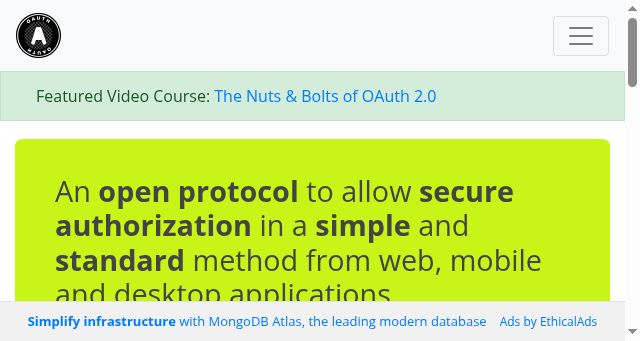
- OAuth — The Open Standard for Authorization
- Description
- OAuth — The Open Standard for Authorization
- Categories
- Upstreams
- aaronparecki.com, oauth2simplified.com, viewsourceconf.org
- Downstreams
- github.com, fusionauth.io
- NS Lookup
- A 172.67.184.237, A 104.21.19.32
- Dates
-
Created 2024-10-13Updated 2026-11-09Summarized 2026-11-14
Screenshot
Query time: 190 ms