- Summary
- Hybrid theory explains human origins by suggesting that early human groups evolved through the blending of genetic material from multiple ancestral lineages, including Neanderthal and Denisovan individuals, while simultaneously mixing genes from other modern ancestors like modern Africans, indigenous Native Americans, and Asians. This theory challenges the concept of a single, isolated gene pool by proposing that humans developed a mixture of genes shared with other hominins and other modern humans, rather than evolving from a solitary group in Africa. The process implies that hybridization events occurred frequently enough to produce diverse traits over millions of years, resulting in the genetic variation seen in the species today. This model offers a mechanism for the rapid accumulation of diversity during the Pleistocene, helping to explain how human populations became more complex and distinct from other extinct species. By acknowledging shared genetic heritage with Neanderthals and Denisovans, this framework provides a more comprehensive view of the fossil record and the biological basis for human adaptability and evolution.
- Title
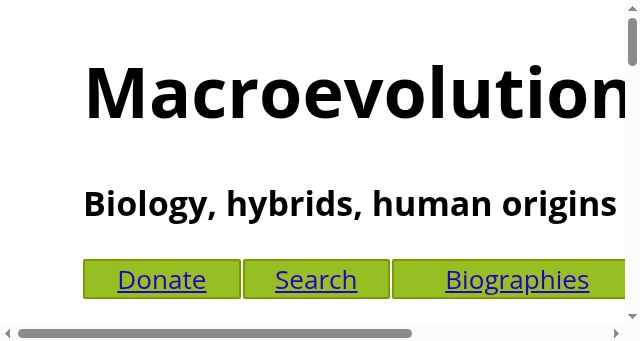
- Macroevolution.net - Biology, hybrids, human origins and more
- Description
- A biology dictionary, science current events, a history of biology, and a new approach to macroevolution and human origins.
- Keywords
- hybrids, origins, biology, human, dictionary, theory, introduction, contents, mammalian, biologists, more, search, biographies, news, contact, book, suffix
- NS Lookup
- A 50.87.145.7
- Dates
-
Created 2026-03-08Updated 2026-03-08Summarized 2026-03-23
Screenshot
Query time: 610 ms