- Summary
- Okay, here's a breakdown of the provided model data, categorized for easier understanding:
I. Overview - Model Size & Architecture
* Dense Models: These models have a relatively uniform architecture – essentially a large number of interconnected neurons.
* Smaller Dense Models (under 30B parameters):
* Qwen 2.5: Ranges from 32B to 72B parameters. Notable for multilingual capabilities and reasoning.
* Command R: 35B parameters, specialized for retrieval-augmented generation (RAG).
* OLMo 2: 32B parameters, focuses on research with a smaller context window.
* EXAONE 4.0: 32B parameters, leveraging hybrid reasoning.
* Larger Dense Models (30B+ parameters):
* Qwen 3.5: Ranges from 122B to 397B parameters. Significant improvements in quality and multimodal capabilities (vision, reasoning, code).
* Qwen 3: 235B and 480B parameters, featuring large MoE architectures.
* Mixtral 8x7B: 47B parameters. A Mixture of Experts model, meaning it utilizes multiple smaller networks that are activated based on the input.
* Llama 4 Maverick: 405B parameters.
* Mixture of Experts (MoE) Models: These models utilize a collection of smaller, specialized networks ("experts"). Only a subset of these experts is activated for any given input, leading to increased efficiency.
* Mixtral: Available in 8x7B and 8x22B variants. The "x" indicates the number of experts.
* Qwen 3: Various sizes (122B, 235B, 397B, 480B) all utilize MoE.
* Llama 4 Maverick: Utilizes a 128E architecture.
* Qwen 3.5: Various sizes (122B, 397B) all utilize MoE.
* DeepSeek V3.1: 671B uses a hybrid thinking and tool use architecture.
* DeepSeek:
* DeepSeek V3.1: 671B, with a hybrid approach to thinking and tool use.
II. Key Features & Capabilities
* Multilingual: Several models (Qwen 2.5, Qwen 3.5, Qwen 3) are specifically designed for multilingual performance.
* Reasoning: Many of the larger models (Qwen 3.5, Qwen 3, Llama 4, DeepSeek V3.1) demonstrate strong reasoning abilities.
* Code Generation: Qwen 3, Qwen 3.5, and the Qwen 2.5 models are optimized for code generation.
* Multimodal: Qwen 3.5 and Qwen 3 are multimodal, capable of processing both text and image inputs.
* Retrieval-Augmented Generation (RAG): Command R is optimized for this.
* Tool Use: DeepSeek V3.1 improves on tool use.
III. Model Size Comparison
| Model Name | Parameters (Approx.) | Context Window |
| ------------------------ | -------------------- | -------------- |
| Qwen 2.5 (32B) | 32B | 2048 |
| Qwen 2.5 (72B) | 72B | 2048 |
| Command R (35B) | 35B | 2048 |
| OLMo 2 (32B) | 32B | 4K |
| Mixtral 8x7B | 47B | 2048 |
| Mixtral 8x22B | 141B | 2048 |
| Qwen 3 (122B) | 122B | 2048 |
| Qwen 3 (235B) | 235B | 2048 |
| Qwen 3 (397B) | 397B | 2048 |
| Qwen 3 (480B) | 480B | 2048 |
| Qwen 3.5 (122B) | 122B | 2048 |
| Qwen 3.5 (397B) | 397B | 2048 |
| Llama 4 Maverick (405B) | 405B | 128K |
| Qwen 3 Coder (480B) | 480B | 256K |
| DeepSeek V3.1 (671B) | 671B | 128K |
Notes:
* Context Window: Refers to the amount of text the model can consider at once. Larger windows generally allow for more coherent and contextually aware responses.
* "A3B" indicates the use of "active" experts in the Mixture of Experts architecture.
* The information is based on the data provided. Specific details about training data, fine-tuning, and performance metrics would require further investigation.
To help me provide even more focused information, could you tell me:
* What are you specifically interested in knowing about these models? (e.g., comparison of their reasoning abilities, best model for a particular task, etc.) - Title
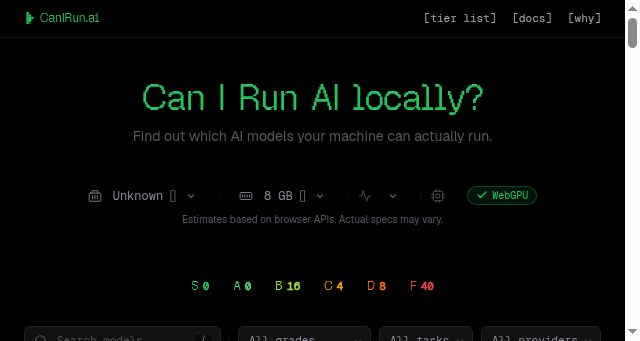
- CanIRun.ai — Can your machine run AI models?
- Description
- Detect your hardware and find out which AI models you can run locally. GPU, CPU, and RAM analysis in your browser.
- Keywords
- architecture, memory, chat, reasoning, active, year, code, model, vision, mistral, gemma, llama, open, context, edge, google, month
- NS Lookup
- A 172.67.201.155, A 104.21.44.173
- Dates
-
Created 2026-03-14Updated 2026-03-14Summarized 2026-03-14
Screenshot
Query time: 933 ms