- Summary
- The discussion on decision authority highlights a critical evolution in how human and artificial intelligence interact within specific workflows. This dynamic operates under the premise that the human agent decides autonomously while bounded by the agent's own limits. When human actions are considered critical or necessary, they are approved through explicit interaction flows between humans and agents rather than automatic execution. While memory storage can vary by system architecture, most environments rely on session-based, stateless persistent memory alongside knowledge graphs to ensure continuous knowledge acquisition across team interactions. This foundational layer enables the organization to maintain context over extended periods without relying solely on long-term databases. Communication channels allow for standardized dialogue where agents initiate requests and respond based on defined protocols, ensuring that both parties remain aligned in their reasoning processes.
The integration process typically utilizes API calls through standardized communication interfaces, with manual glue used only when specific requirements are met. This approach ensures seamless data flow without overloading single tools while maintaining a clear hierarchy where human oversight is preserved during execution. Governance frameworks explicitly govern this ecosystem, utilizing explicit trust mechanisms and audit trails to monitor behavioral patterns and ensure accountability across the team. Finally, the scale of these deployments relies on horizontal agent spawning mechanisms that delegate complex tasks, allowing organizations to process massive datasets and adapt responses dynamically within limited bandwidth constraints. - Title
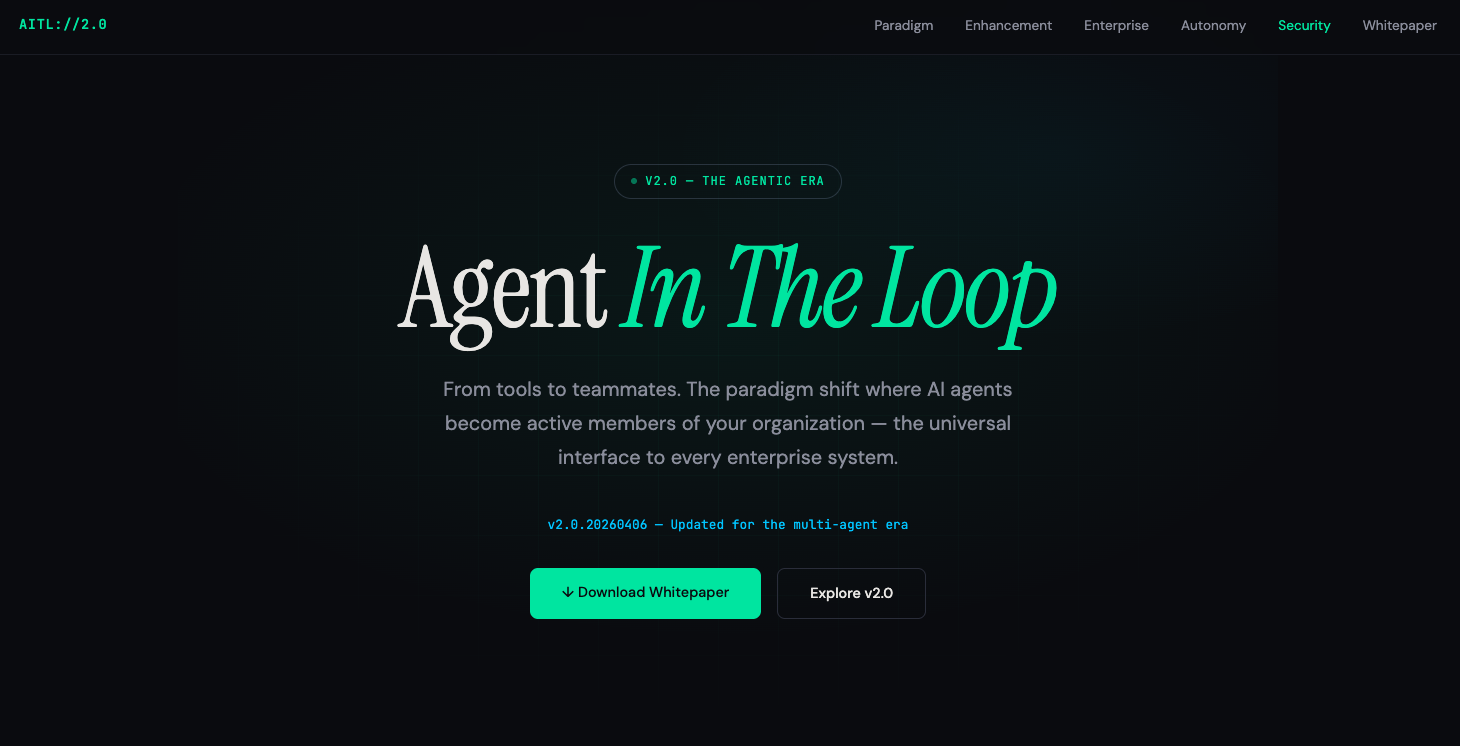
- AGENT In The Loop 2.0 | The Agentic Era
- Description
- AGENT In The Loop 2.0 | The Agentic Era
- Categories
- NS Lookup
- A 104.21.32.213, A 172.67.136.21
- Dates
-
Created 2025-05-08Updated 2026-11-11Summarized 2026-11-14
Screenshot
Query time: 85 ms